Buying a Home This Fall? Here’s What Canada’s Mortgage Rules Mean for You

If you’re thinking about buying a home, mortgage headlines can leave you wondering whether qualifying is getting easier or harder.
The answer? It depends on your situation. But some of the changes you’ve been hearing about could give you more options.
Expanded access to 30-year amortizations and a higher price limit for insured mortgages took effect in December 2024. For eligible buyers, these changes can mean a smaller down payment or a more manageable monthly payment. They don’t guarantee approval, but they’re worth understanding before you start house hunting.
Here’s what we’d want you to know.
A 30-year mortgage could give your budget some breathing room
Your amortization is the length of time your mortgage is scheduled to take to pay off.
For eligible buyers putting down less than 20%, a 30-year amortization is available if you’re a first-time buyer or purchasing a newly built home. Other insured purchases generally remain limited to 25 years.
Spreading payments over 30 years instead of 25 typically lowers the required monthly payment. It may also help you qualify, depending on your income, debts and the lender’s requirements.
The trade-off? Paying your mortgage over a longer period generally means paying more interest overall. You may be able to make extra payments along the way, within your mortgage’s prepayment limits.
At COPA, we’d look at both options with you. What does each payment feel like? How much room does it leave for savings, family expenses and the things you enjoy?
Being approved for a mortgage is one thing. Feeling comfortable with it every month matters just as much.
You may not need 20% down on a home over $1 million
Previously, buying a home priced at $1 million or more generally meant putting at least 20% down.
The insured mortgage price limit has since increased, allowing eligible buyers to purchase a home priced below $1.5 million with less than 20% down.
For an eligible purchase, the minimum down payment is:
Up to $500,000: 5% of the purchase price.
Over $500,000 and below $1.5 million: 5% on the first $500,000, plus 10% on the remaining amount.
$1.5 million or more: At least 20%.
Here’s how that looks:
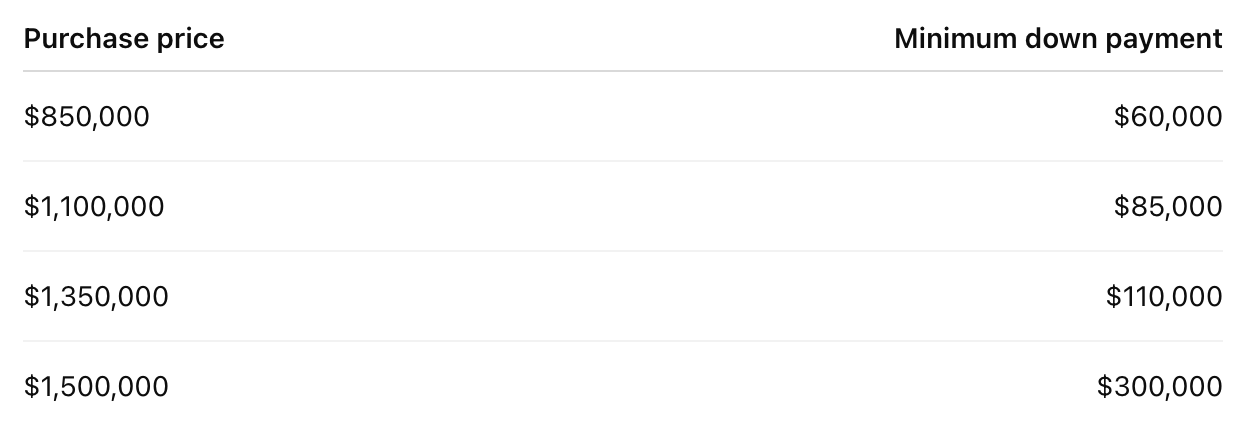
These examples assume an eligible purchase and exclude closing costs and mortgage default insurance.
A smaller down payment can make buying sooner possible. But it also means borrowing more, and mortgage default insurance is generally required when you put down less than 20%. That insurance protects the lender, and its premium adds to your cost.
We’d help you compare the full picture before deciding how much to put down.
Yes, the mortgage stress test still matters
These changes haven’t removed the stress test for home purchases.
At federally regulated lenders, you generally need to qualify at the higher of:
Your mortgage interest rate plus two percentage points.
5.25%.
That qualifying rate helps assess whether you could manage payments at a higher rate. It isn’t necessarily the rate you’ll actually pay.
Your income, existing debt payments and the property’s expenses still affect what you can borrow. A longer amortization may help, but it doesn’t remove those requirements.
That’s why we like to review the numbers early. Before you’ve found the kitchen you love and mentally moved your furniture in.
Renewing instead of buying? You may have more flexibility, too
If you have an uninsured mortgage coming up for renewal, an eligible straight switch between federally regulated lenders can be exempt from the prescribed stress test, provided you don’t increase your mortgage amount or remaining amortization.
The new lender still needs to approve your application. Taking out extra money or extending your repayment timeline is a different conversation.
It’s worth reviewing your options before signing your renewal offer.
If you’re considering refinancing your mortgage, we’ll help you compare the costs and benefits.
Start with your numbers, then start shopping
If buying is on your radar this fall, here’s where we’d begin:
Find your comfortable payment. Your budget should leave room for life beyond the mortgage.
Review your income and debts. We can help identify what affects your qualification before you make changes or use savings to pay something off.
Plan for closing costs. Your down payment is only part of the cash you’ll need.
Review your eligibility. We’ll help you understand which mortgage options fit your situation.
Get pre-approved. This helps guide your search, but final approval still depends on the lender’s review of your finances and the property you choose.
Let’s figure out what this means for you
You don’t need to become a mortgage expert before buying a home. That’s what we’re here for.
At COPA Mortgage, we’ll walk you through your options, explain the trade-offs and help you find a payment that fits your life and your plans.
Thinking about buying or approaching renewal? Reach out to Colleen and Paula. We’d love to help you work through the numbers and chat about your mortgage options!
